What Quantum Careers Actually Exist?
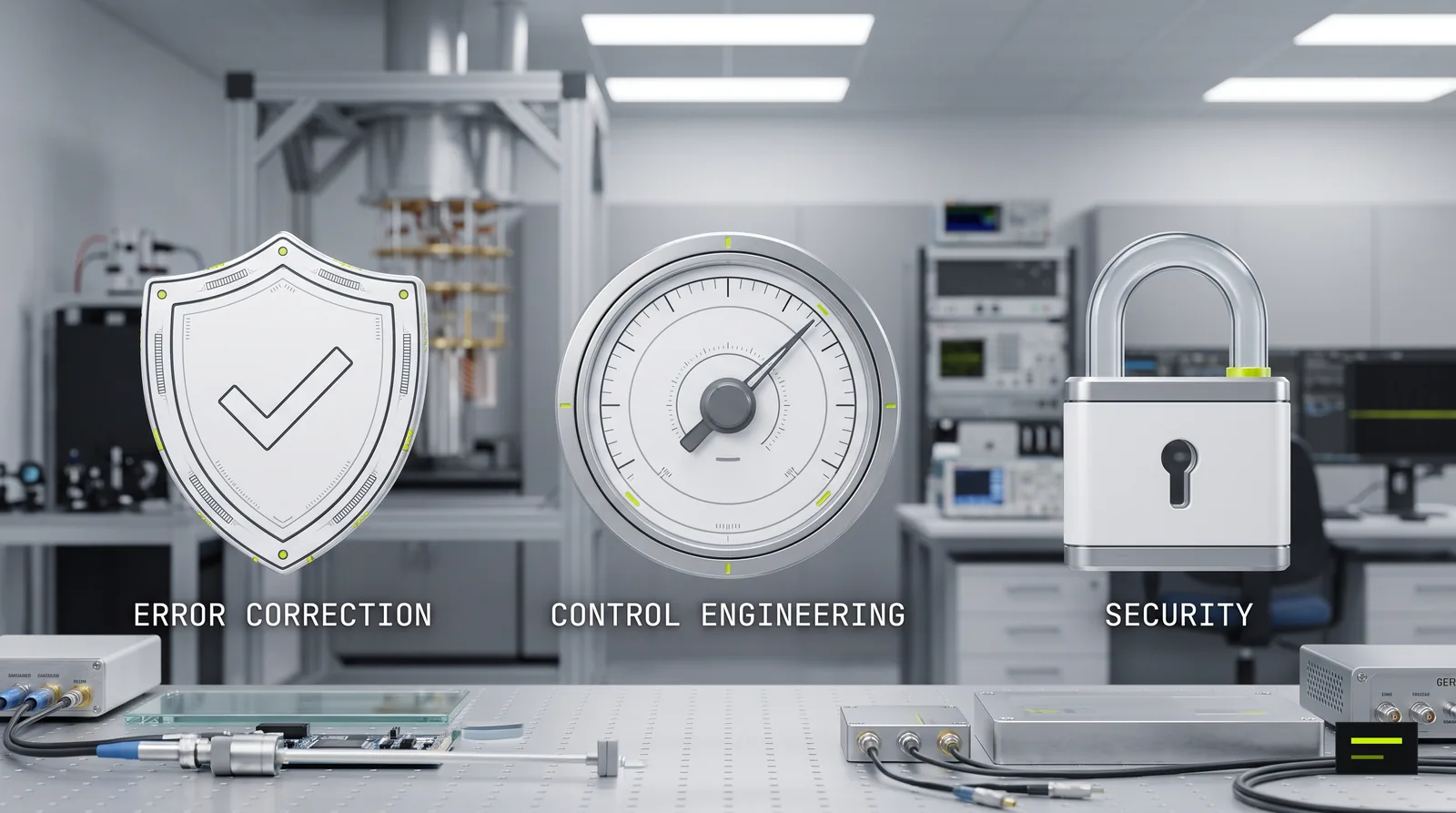
Quantum careers fall into three broad clusters, hardware, software and applications, but the field also has narrower specializations worth knowing by name: error-correction research, quantum control engineering and quantum security. The entry bar is also lower than the stereotype suggests.
This guide maps the field: the main clusters, the specialist roles, what employers actually ask for, and where to go next depending on your background.
The three broad clusters
- Hardware: building and calibrating the physical qubits and the electronics around them.
- Software and algorithms: writing the circuits, compilers and algorithms that run on that hardware.
- Applications: applying quantum methods to problems in chemistry, finance and other industries.
The differences between them are explained in what a quantum engineer is. Most careers start in one of the three.
Specialist roles worth knowing
Inside hardware and software, a few roles appear often enough in job postings and lab structures to name individually.
- Quantum error-correction researcher. Designs the codes that protect fragile qubits from noise. It is one of the field's hardest open problems.
- Quantum control engineer. Works in the layer between the physical qubits and the software that addresses them: pulse shaping and calibration routines.
- Quantum cryptography and security specialist. Assesses which of today's encryption will survive a future quantum computer, helps organizations move to post-quantum standards, and builds systems such as quantum key distribution.
What credentials employers ask for
The bar varies more than the stereotype suggests, and this is a case where it is worth checking the data instead of repeating the common assumption. Research and hardware-adjacent specialties do tend to expect a master's degree or a PhD in physics, electrical engineering or applied mathematics. But that is not the whole field. The Chicago Quantum Exchange's 2024 study, built from more than 5,000 quantum job postings, found that 55% of the roles posted in 2023 required no more than a bachelor's degree. The full breakdown is in is there a quantum talent shortage. Better tooling, such as browser-based circuit builders and higher-level SDKs, is lowering the floor on the software and applications side faster than on hardware, which still needs deep lab-specific expertise.
Where the jobs are
Most roles cluster at quantum hardware companies, national laboratories and the research divisions of a few large technology firms. In India, the National Quantum Mission funds thematic hubs at IISc Bengaluru for computing, IIT Madras for communication, IIT Bombay for sensing and metrology, and IIT Delhi for quantum materials and devices. Those institutions are natural places to look for research and lab positions.
Roles that are not engineering
A growing share of quantum companies also hire for technical writing, program and project management, business development and scientific sales. These roles still need real fluency in the subject, but they do not need you to build qubits or write algorithms.
Choosing a direction
Start from where you are. If you write code, read the software engineer pathway. If you come from electronics, RF or cryogenics, read the electronics engineer pathway. If you are a physicist, read the physicist pathway. If you work with data, read the data scientist pathway.
Frequently asked questions
Do you need a PhD to work in quantum computing?
Not for all roles. Research and hardware specialties often expect a master's or PhD, but the Chicago Quantum Exchange's 2024 study of more than 5,000 postings found that 55% of the roles posted in 2023 required no more than a bachelor's degree.
Can a software engineer move into quantum computing?
Yes, and it is one of the more approachable routes. Programming fluency and Python transfer directly. The new parts are linear algebra with complex numbers and thinking in circuits, and working fluency typically takes months of steady study.
How much do quantum computing jobs pay?
It varies widely by country, employer and role, and quantum roles are too few for a single reliable average. Check current postings and salary data for your region and level, and treat headline figures with caution.
Is quantum computing a good career?
It is a real and growing field, but still small and concentrated in a few companies, labs and research divisions. That means fewer openings than software engineering, and more uncertainty about how fast hiring will grow.
Are there quantum jobs for people who do not code?
Yes. Companies also hire for technical writing, program management, business development and scientific sales. These roles still require a working understanding of the technology.
Every quantum career starts from the same foundation. Quantum States is Quantum Discord's free introductory course, with a live workshop and interactive simulations.
Explore the Quantum States courseNot sure which pathway fits? The Role Navigator matches one to your actual background.
- Department of Science & Technology, Government of India, National Quantum Mission. dst.gov.in/national-quantum-mission-nqm
- Chicago Quantum Exchange, "Quantum Tech Job Accessibility: 2024 CQE Study." chicagoquantum.org/degreereports