Physicist → Quantum Research: What Changes and What Doesn’t
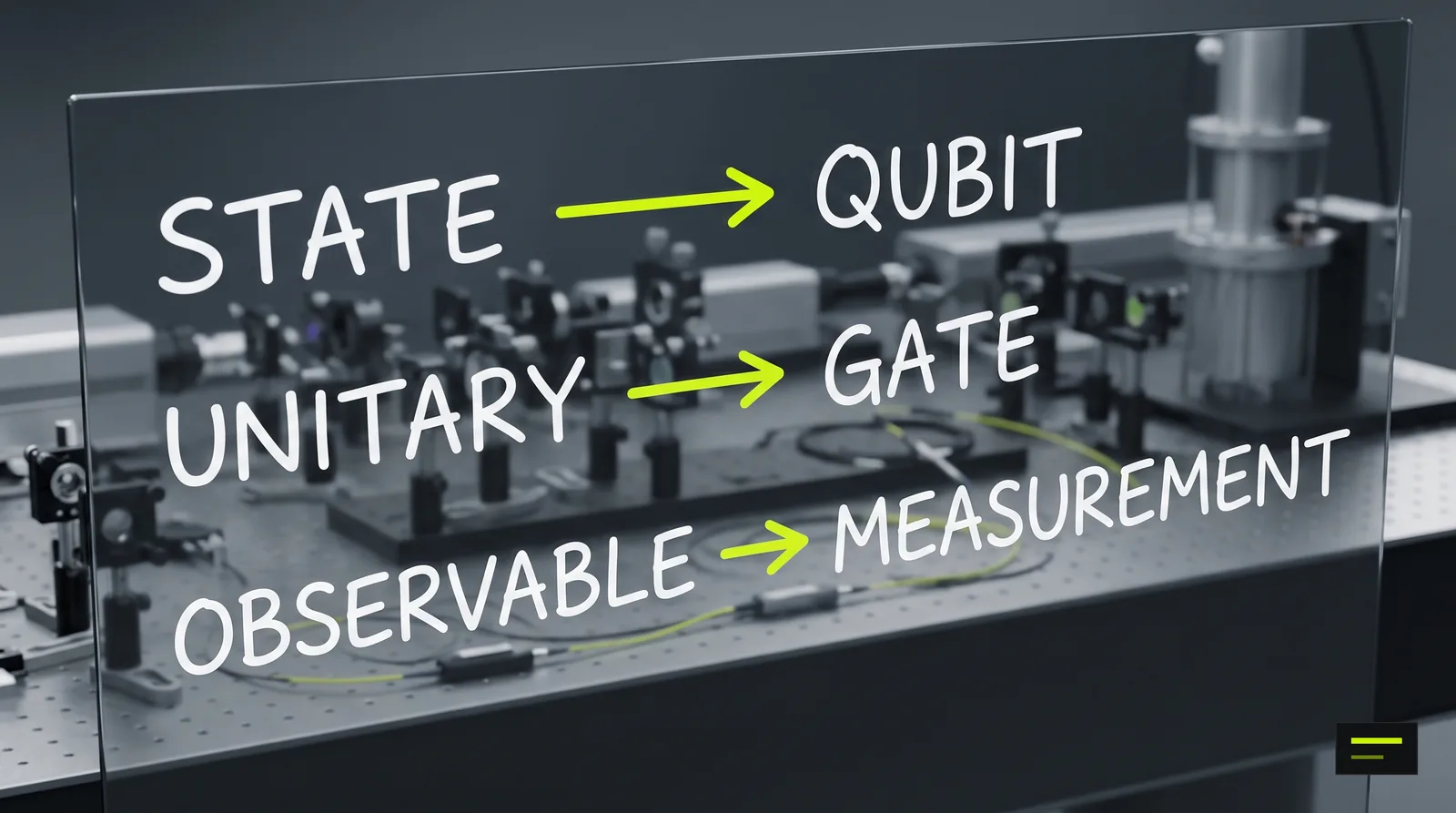
If you already know quantum mechanics, you are not starting over. Quantum computing mostly restates familiar ideas in information-theoretic language. What is new is quantum information theory itself, plus hands-on tooling that most physics degrees never touched.
This pathway maps the vocabulary shift, names what is genuinely new, describes the practical gap, and suggests the fastest way through for someone who already has the physics.
The vocabulary shift
If you know the postulates of quantum mechanics, Hilbert spaces and operators, you are relearning familiar ideas through a new vocabulary:
- A two-level system with a state vector becomes a qubit.
- An observable measured in an eigenbasis becomes a measurement in a chosen basis.
- Unitary time evolution becomes a gate, and a sequence of gates becomes a circuit.
- The tensor-product structure of composite systems becomes multi-qubit registers, and entanglement becomes a resource.
- Density matrices and decoherence become the language of noise.
What is genuinely new
Quantum information theory is the real addition: entanglement measures, the no-cloning theorem, teleportation, and the idea that information itself is a physical, quantum resource. On top of that come error-correcting codes, such as stabilizer codes and the surface code, and computational complexity, including which problems a quantum computer can solve efficiently. Finally there is the circuit model, a way of describing a computation as gates on qubits, along with the algorithms built on it, such as Shor's, Grover's, phase estimation and variational methods.
The hands-on gap
The skill physics degrees rarely teach is tooling. That means writing and running real circuits with an SDK, understanding how a circuit is compiled onto a device with limited connectivity, reading noisy results, and running jobs on cloud-accessible quantum hardware. This is where the actual new skill lives, and it is learned by doing, in Python.
The fastest path
The fastest route is usually not to start from the beginning. Skim the early conceptual material quickly to pick up the vocabulary shift, then spend real time on measurement in the quantum-information framing and on the tools. Measurement is the topic where familiar physics meets the new formalism most directly, including measurement bases, partial measurement and disturbance. Then build circuits and run them on real hardware. Move quickly through the physics you already know, and slow down once you reach the tooling.
Common traps for physicists
Three assumptions cost physicists time. The first is treating any quantum system as a computer: a quantum computer needs controllable, measurable qubits and a way to fix errors. The second is underestimating complexity theory, which decides whether a speedup is real. The third is underestimating software: modern quantum research runs on code, version control and reproducible experiments, so invest in those early.
Where physicists are most needed
Physics training matters most in error correction and fault-tolerance research, in qubit design and modeling, in quantum simulation of materials and chemistry, and in quantum sensing. The career map lists the specialist roles, and the quantum engineer article explains how hardware, software and applications differ.
Quantum Measurement covers measurement bases, operators, disturbance, collapse and partial measurement, the bridge between the physics you know and quantum information. Skim the free Quantum States course first for the vocabulary.
Explore the Quantum Measurement courseThen move to tooling in the Circuit Builder.