What Math Do You Need for Quantum Computing?
The math you need for quantum computing is mostly linear algebra with complex numbers, plus basic probability. You do not need a physics degree first. Complex numbers, vectors, matrices, inner products and probability will carry you through a single qubit and simple circuits.
This article separates what you need now from what can wait, shows the one calculation that ties it together, and explains the most common mistake: treating the list as a wall to climb before you are allowed to start.
What you need now
- Complex numbers. Amplitudes are complex, with a size and a phase. Euler's formula, eiφ, is the piece to be comfortable with.
- Vectors. A qubit's state is a two-component vector, and multi-qubit states are longer vectors.
- Matrices. Quantum gates are matrices acting on those vectors, and they are unitary, meaning they preserve length and are reversible.
- Inner products. The overlap between two states, and the source of measurement probabilities.
- Basic probability. Measurement outcomes are random, and results are read from distributions over many runs.
Here is the whole toolkit in one line. The Hadamard gate is a matrix, and applying it to the state 0 is a matrix acting on a vector:
The result is an equal superposition. The probability of each outcome is the squared size of its component, here one half each.
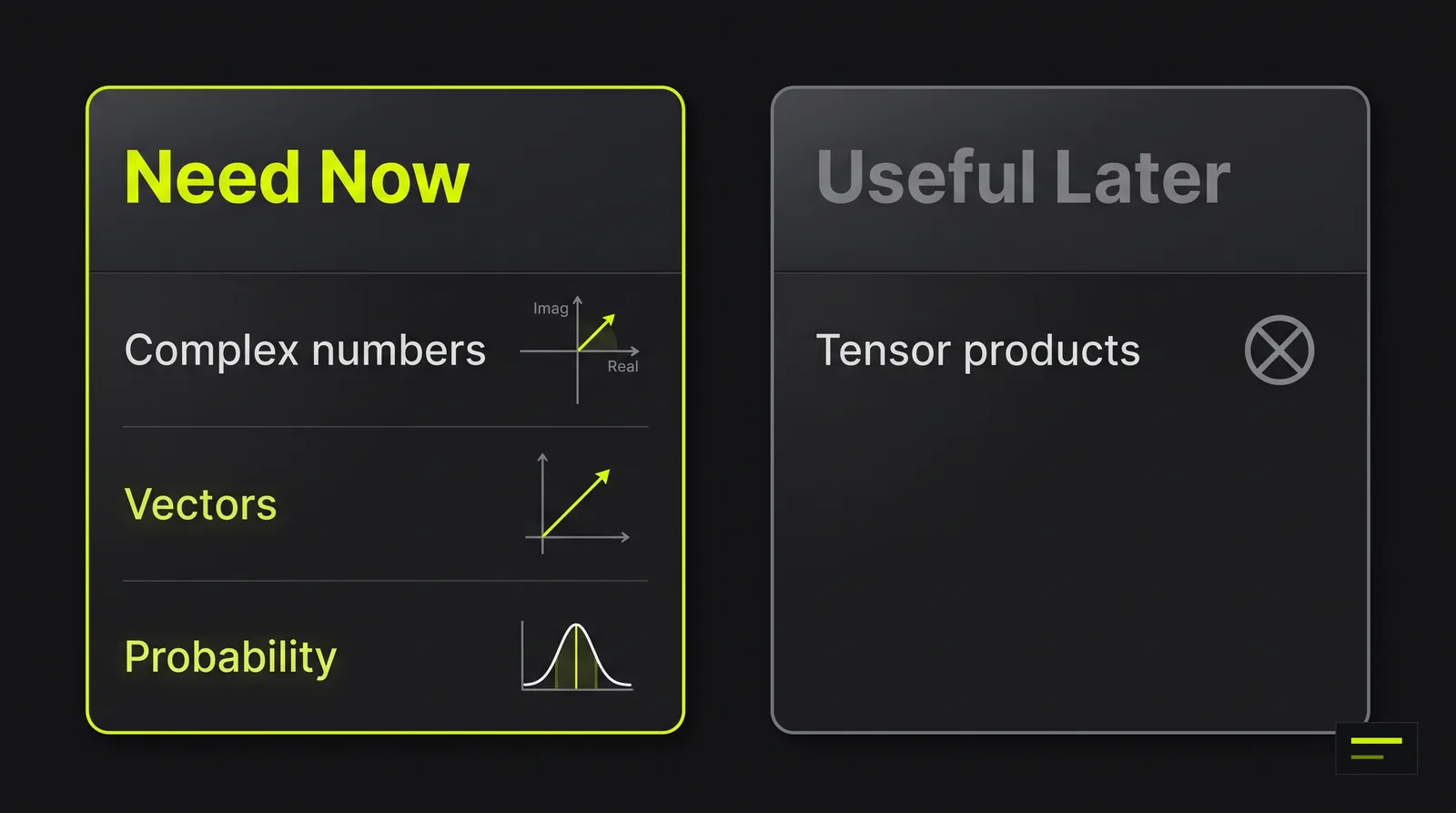
What can wait
- Dirac (bra-ket) notation. Mostly a compact way of writing what you already know. An hour or two is enough.
- Tensor products. Needed to describe several qubits together, so they arrive naturally when you meet entanglement.
- Eigenvalues and eigenvectors. Useful for understanding measurement and evolution more deeply, after the basics feel comfortable.
The mistake: treating it as a wall
The common mistake is treating this list as something to clear before starting. It does not have to be sequential. The math is more intuitive when you learn it alongside the physics it describes, and abstract prerequisites studied months beforehand tend to be forgotten. A vector makes far more sense once you have seen it point to a state on the Bloch sphere. Learn a piece, use it on a qubit, and move on.
A quick self-test
If you can do this in your head, you have the core. A qubit is in the state \(\tfrac{\sqrt{3}}{2}|0\rangle + \tfrac{i}{2}|1\rangle\). What is the probability of measuring 0? Square the size of the amplitude: \((\sqrt{3}/2)^2 = 3/4\). The factor of \(i\) changes the phase but not the probability, and the two probabilities, 3/4 and 1/4, sum to 1. If the steps felt natural, you are ready for single-qubit circuits.
How to study it
Pair a standard linear algebra resource with quantum material instead of finishing one first. Gilbert Strang's linear algebra lectures on MIT OpenCourseWare are a widely used free choice, and IBM Quantum Learning offers a free course on the basics of quantum information. If you code, check every idea in Python with a few lines of NumPy. The programming you need is a short list too, and the software engineer pathway shows how the two fit together.
Quantum States introduces each mathematical idea as it is needed, alongside the physics it describes. It is Quantum Discord's free introductory course, with a live workshop and interactive simulations.
Explore the Quantum States course