Software Engineer → Quantum Computing: A Realistic Pathway
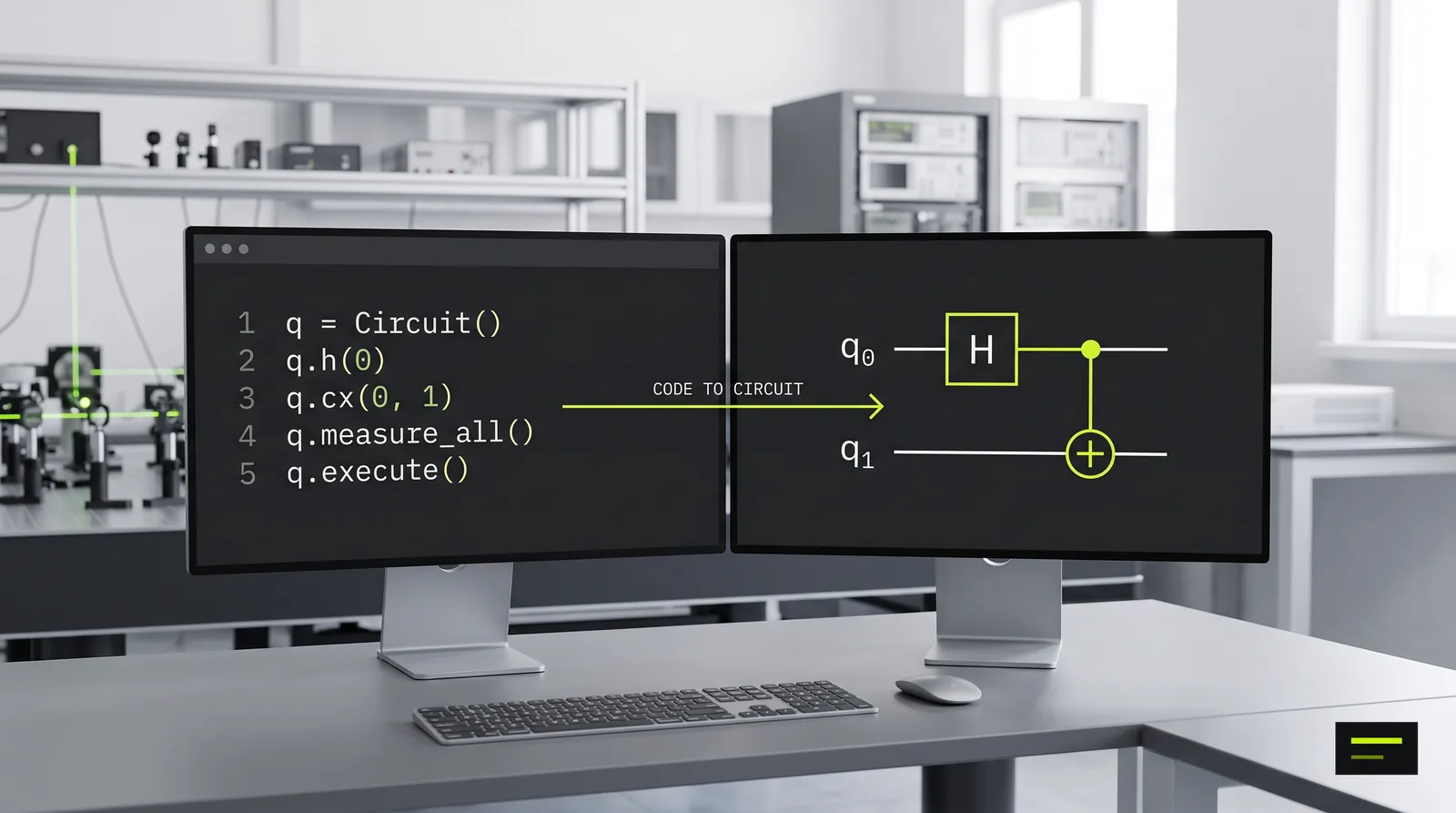
If you already write code, quantum computing is one of the more approachable entry points into the field. You bring programming fluency and Python. You need to add linear algebra, probabilistic thinking and a new mental model: circuits instead of instructions. Working fluency takes months, not weeks, and it does not take a physics PhD.
This pathway covers what transfers from your current skills, what is genuinely new, a realistic timeline, and a concrete first month.
What transfers directly
- Programming fluency and abstraction. Quantum programs are built from layers of abstraction like any other software.
- Python. Qiskit, Cirq and PennyLane are all Python libraries, so your existing habits carry over.
- A debugging mindset. Reading noisy results and isolating what went wrong is central, because real hardware never behaves perfectly.
- Cloud workflows. Real quantum hardware is reached as a cloud service: you submit a job, wait in a queue, and read back results.
A realistic sequence
The order that tends to work is concepts first, since they are free to start and immediately useful. The math runs alongside them instead of gating them. Circuits and code come after that. Figure 1 shows the shape of it.
What is genuinely new
Three things. First, linear algebra with complex numbers, since a qubit's state is a vector and a gate is a matrix (the math you need is shorter than most people fear). Second, probabilistic program behavior: the same circuit can return different results, and you read the answer from statistics over many runs. Third, a different mental model, thinking in circuits and gates instead of sequential instructions.
Try it liveBuild the exact circuit in Figure 2 yourself, no install, in the Circuit Builder.
A realistic timeline
The honest timeline sits between the two extremes you see online. It is not "quantum in three weeks", and it is not "you need a physics PhD". Solid working fluency, enough to build and reason about real circuits, is achievable in months of consistent study for someone who already codes. Contributing to actual algorithm research is a longer and separate bar, closer to a graduate-level specialization.
Common pitfalls
Engineers tend to trip on the same few things. They expect a speedup on ordinary problems, when quantum helps only on a short list. They skip the math and then cannot read a circuit. They stop at simulators and never see what noise does to a real result. And they trust headlines about "quantum advantage" without asking what the classical baseline was. Keep a healthy skepticism, the same one you would bring to any benchmark.
Your first month
- Week 1. Read what a qubit is, then build a two-qubit entangled circuit in the Circuit Builder.
- Week 2. Refresh vectors, matrices and complex numbers, and apply them to a single-qubit gate by hand.
- Week 3. Write and run your first circuit in code with an SDK, using a free cloud account or a local simulator.
- Week 4. Implement a tiny algorithm, such as Grover search on two qubits, and check that the measured statistics match the theory.
Quantum States is Quantum Discord's free introductory course, the concepts-first start this pathway recommends. It includes a live workshop and interactive simulations.
Explore the Quantum States courseA practical sequence: concepts, then the Circuit Builder, then the Coding Lab.