01 · Searching smarter
Weighting outcomes toward the right one.
Classical systems often examine possibilities one at a time. Quantum systems use interference to make useful answers more likely.
Learn quantum technology through interactive experiences, simulations, coding, and guided exploration, at your own pace.
Tilt the qubit, then measure it. You always get 0 or 1. The angle only changes the odds. Measure many copies and the pattern appears.
That's superposition and the Born rule, the first two ideas in quantum computing. The free course explains why it works.
Start the free course →Pick a gate, tap a slot. The results and the Qiskit code update as you go. This one starts as a Bell state.
Tap a slot to place the selected gate. Tap a gate to remove it. CNOT: tap the wire that should be the control.
Try this: remove the CNOT. The result 11 disappears.
Loading the circuit engine……Computed in your browser. The Coding Lab runs this same code with Qiskit on our server and prints counts in this form. Shots are random, so counts change each run.
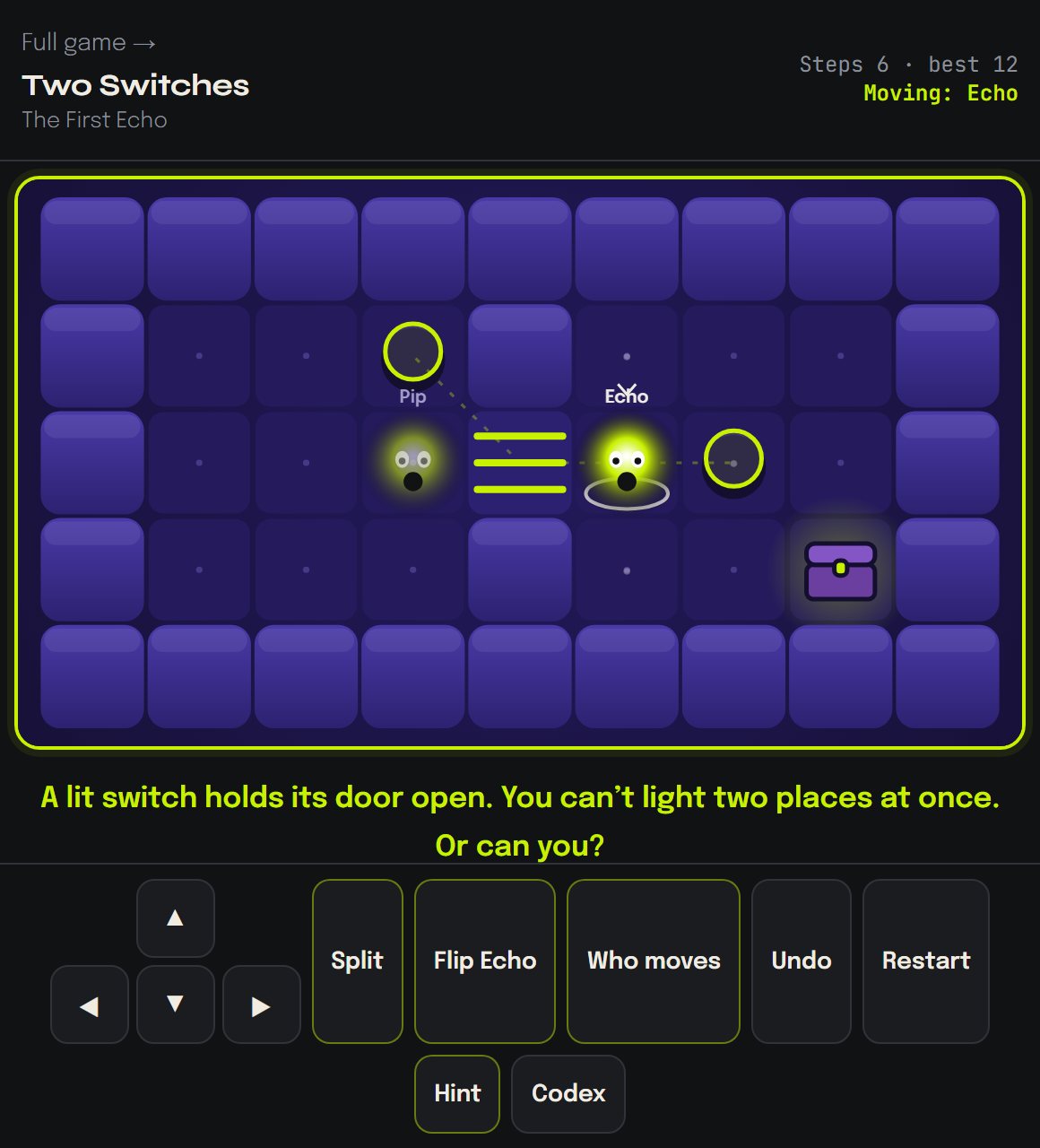
Pip can split into two twins. Use both to light the switches, open the door and reach the treasure.
Free, with arrow keys or a swipe. This is one room from the game. The other 14 rooms are on the Games page.
Three examples of what that makes possible.
Classical systems often examine possibilities one at a time. Quantum systems use interference to make useful answers more likely.
Measuring a quantum state disturbs it, so any attempt to listen in shows up through the laws of physics.
Quantum interference is very sensitive to tiny changes, which is why quantum clocks and sensors are so precise.
Quantum technology is moving from research laboratories into real-world applications.
Students, educators, developers, engineers, scientists, and professionals will increasingly interact with quantum systems in the coming decades.
Learning quantum technology today positions you at the frontier of a field that will reshape computing, communication, medicine, and materials science, before the mainstream catches up.
Quantum technology spans physics, mathematics, computer science, and engineering. As the field grows, it can feel challenging, because it introduces genuinely new ways of thinking about information, measurement, and computation. Quantum Discord simplifies that journey through visual learning, interactive exploration, simulations, coding, and guided workshops, designed for every starting point.
Every field above is developing quantum strategies today. The professionals who understand quantum will shape how each industry transitions.
Four fields, and where each one is already being applied.
Process information using qubits in superposition, targeting the specific classes of problems where classical computers scale poorly.
Build communication networks secured by quantum mechanics, where eavesdropping is physically revealed, not just computationally hard to crack.
Detect time, gravity, magnetic fields, and motion at precisions that fundamentally surpass what classical physics allows.
Design and simulate advanced materials at the atomic level, creating the physical hardware that will power the quantum future.
No. You do not need any quantum background. The courses teach the maths they use as you go. School algebra, trigonometry and basic calculus are enough to begin.
The first course, Quantum States, is free. The qubit demo on this page needs no sign-up.
Yes. The courses are taught live by qualified instructors. Class dates appear on the Learn page when they are scheduled.
Read the refund policy before you buy.
Quantum technology is transforming how we compute, communicate, sense, and engineer the world around us. Quantum Discord provides an intuitive pathway to explore and understand it, from first curiosity to genuine competence.