What Is a Quantum Engineer?
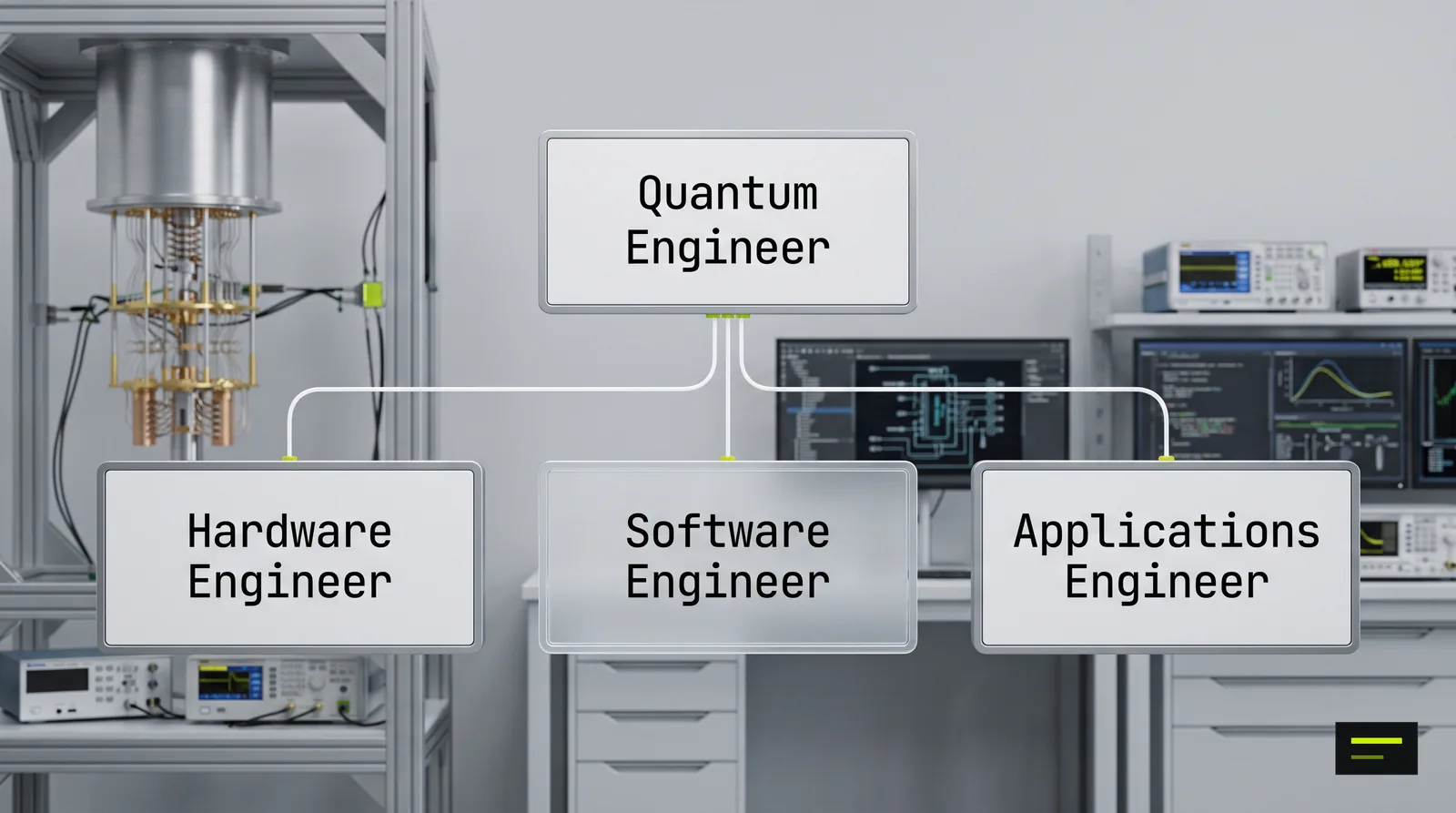
"Quantum engineer" is not one job. It is an umbrella over three genuinely different day-to-day roles: hardware, software and algorithms, and applications. Which one someone means depends on the company or lab that is hiring.
If you have seen the title in a job posting and wondered what it involves, this article separates the three roles, says who typically hires for each, and helps you work out which one fits your background.
Hardware and device engineers
These engineers build and calibrate the physical qubits, whether superconducting circuits, trapped ions or photonics, along with the cryogenics, control electronics and calibration software that keep them stable. The work looks close to experimental physics and electrical engineering. A typical day might involve tuning microwave pulses, chasing a source of noise, or improving how long a qubit stays coherent, and progress is measured in microseconds and milliseconds of coherence time.
Quantum software and algorithm engineers
These engineers write the circuits and code that run on that hardware, using SDKs such as Qiskit, Cirq or PennyLane, and at the research end they design new algorithms. Day to day it can mean building compilers that map a circuit onto a real device, reducing the effect of noise, or benchmarking a method against a classical baseline. This work looks closer to computer science or applied mathematics than to physics, and it is the role most open to people who already code. The software engineer pathway covers the route in.
Applications and domain engineers
These engineers sit on top of both. A chemist deciding which molecule is worth simulating, or a finance quant testing an optimization idea, is doing this job: translating a real industry problem into something a quantum algorithm could plausibly help with. It is the newest and least standardized of the three roles, and domain knowledge counts for as much as quantum knowledge.
How common each role is
Today, most positions carrying this title sit at quantum hardware companies, national laboratories, or the research divisions of a small number of large technology firms. It is a real and growing field, but still small and concentrated, not yet a mainstream job category the way "software engineer" is. Because titles are used loosely, always read the job description before assuming which of the three roles it is.
Skills each role leans on
- Hardware: RF and microwave engineering, cryogenics and vacuum systems, FPGAs and real-time control, measurement and calibration.
- Software and algorithms: Python, linear algebra, compilers or optimization, and statistics for reading noisy results.
- Applications: deep knowledge of a field such as chemistry or finance, plus enough Python and quantum fluency to test ideas.
Which one fits you
A rough guide: a background in physics or electrical engineering points toward hardware, and the electronics engineer pathway shows what transfers. A computer science or software background points toward the software role. Deep expertise in another field, such as chemistry, finance or machine learning, points toward applications. Physicists heading toward research can read the physicist pathway. If you are not sure, the Role Navigator matches a pathway to your background, and what quantum careers exist maps the wider field.
Whichever role you choose, the foundation is the same. Quantum States is Quantum Discord's free introductory course, with a live workshop and interactive simulations.
Explore the Quantum States course