Electronics Engineer → Quantum Hardware: A Realistic Pathway
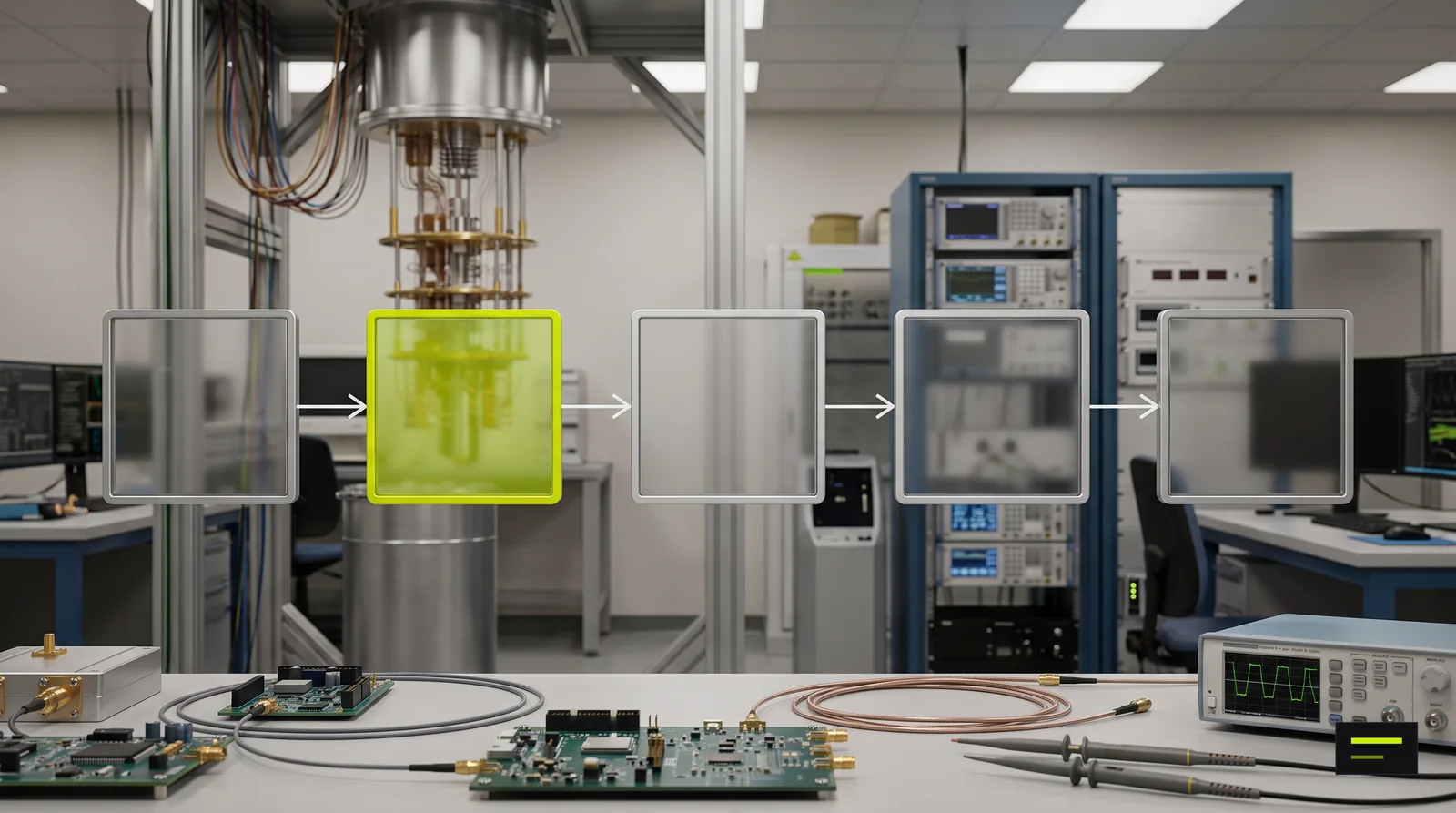
Electronics engineers are closer to quantum hardware than they usually assume. RF engineering, control systems and cryogenics map onto how superconducting and other qubits are built and operated. The genuinely new part is the physics layer: why a qubit behaves the way it does, and which errors are unique to quantum devices.
This pathway shows what transfers, what the hardware stack looks like from a laptop down to a qubit, what you would need to learn, and where quantum hardware teams recruit.
What transfers
- RF and microwave design. Superconducting qubits are controlled with microwave pulses, typically at a few gigahertz, so signal integrity, filtering and mixers are daily concerns.
- Low-noise electronics. Reading a qubit means detecting a tiny signal, and every source of noise counts.
- Control systems and real-time hardware. Experiments run from FPGAs and arbitrary waveform generators, with tight timing.
- Cryogenics and vacuum. If you have it, it is a real differentiator. Most qubit platforms run at temperatures colder than deep space.
The stack between a laptop and a qubit
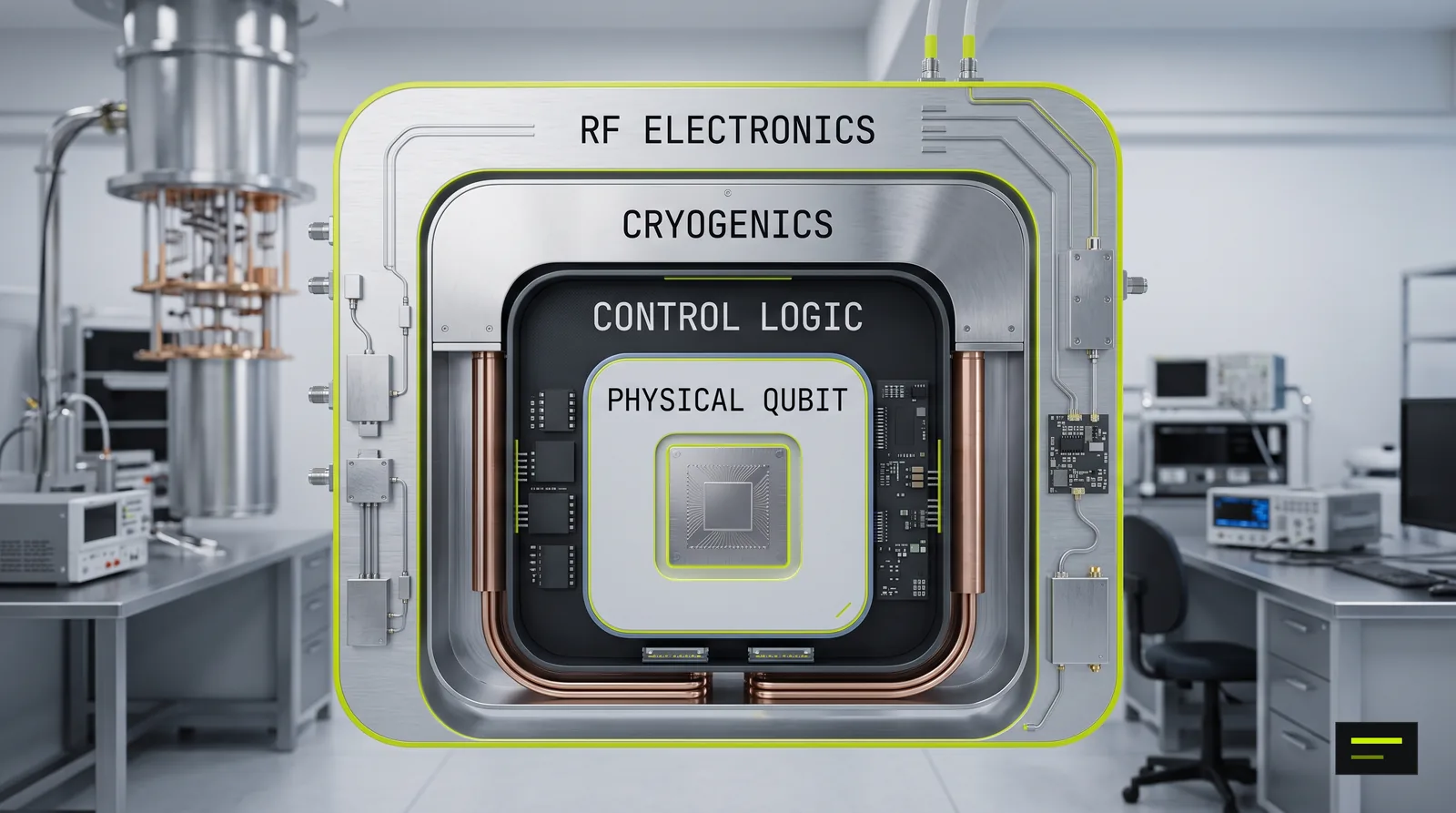
A superconducting quantum computer is a set of nested layers. At room temperature sit the RF electronics that generate and read signals. Those feed lines into a dilution refrigerator, which cools the chip to roughly 10 to 20 millikelvin, and heavy filtering and attenuation stop warm noise from reaching it. Control logic manages what gets sent, and at the center sits the physical qubit. Almost every layer except the last one is recognizable electronics engineering.
What is genuinely new
What you have to add is the quantum-mechanical picture underneath. Why does a qubit lose its state? Decoherence limits how long a qubit stays usable, from microseconds to around a millisecond on typical devices. Crosstalk means an operation on one qubit disturbs its neighbors, and calibration drifts as conditions change. Measuring a qubit also disturbs it. These error sources have no close analogue in classical electronics, and understanding them is what lets you reason about why a design choice matters at the qubit level, not just whether the circuit works.
Where quantum hardware teams hire
Many quantum hardware teams recruit from RF engineering, cryogenics and semiconductor fabrication, not only from physics PhD programs, because those skills already transfer with real value. The gap most electronics engineers have to close is not the engineering. It is building enough of the underlying physics to talk to the physicists on the team. The wider role landscape is in what a quantum engineer is.
What to study first
Start with the single-qubit picture: the Bloch sphere, gates as rotations, and measurement. Then learn how a superconducting qubit is described as an anharmonic oscillator and why microwave pulses rotate it. Fabrication experience carries over too, since superconducting circuits are made with lithography and cleanroom processes that resemble semiconductor work.
An honest gap in our own curriculum
Quantum Discord's curriculum today is strongest on quantum concepts and software, not on hardware engineering specifically. Quantum control, cryogenics and quantum fabrication are not covered here yet. This pathway starts you on the shared conceptual foundation, and the hardware-specific depth you will need to build from other sources and on the job.
Build the physics foundation first. Quantum States is Quantum Discord's free introductory course, with a live workshop and interactive simulations.
Explore the Quantum States courseExplore the physics interactively in the Simulations gallery.