What Is a Qubit?
A qubit, short for quantum bit, is the basic unit of information in a quantum computer. It plays the role a bit plays in your laptop, with one crucial difference: before it is measured, a qubit's state is a weighted combination of 0 and 1, not a plain 0 or 1.
This article covers what a qubit is mathematically, what qubits are physically made of, why measuring one destroys its superposition, and why the number of qubits alone is a poor way to rank a quantum computer.
A qubit compared with a bit
A classical bit has exactly two possible states, 0 or 1. A qubit's state is described by two numbers called complex amplitudes: one weighting how 0-like it is, one weighting how 1-like it is. Both can be nonzero at the same time. That is superposition. It does not mean the qubit is secretly 0 or 1 and we just do not know which. That would be ordinary uncertainty, like a coin under your hand. The mathematics and the experiments both show the qubit is genuinely in a combined state until it is measured.
The state of a qubit in one line
\(\alpha\) and \(\beta\) are the amplitudes drawn as the vector in Figure 1. Squaring their sizes gives the probability of measuring 0 or 1, and those two probabilities always add to 1.
Geometrically, every possible state of a single qubit is a point on the surface of a sphere, the Bloch sphere in Figure 1. The north pole is |0⟩, the south pole is |1⟩, and a superposition sits somewhere in between. Two numbers fix the point: how far it is from the poles, which sets the measurement probabilities, and how far around the sphere it sits, which is called the relative phase.
What a qubit is made of
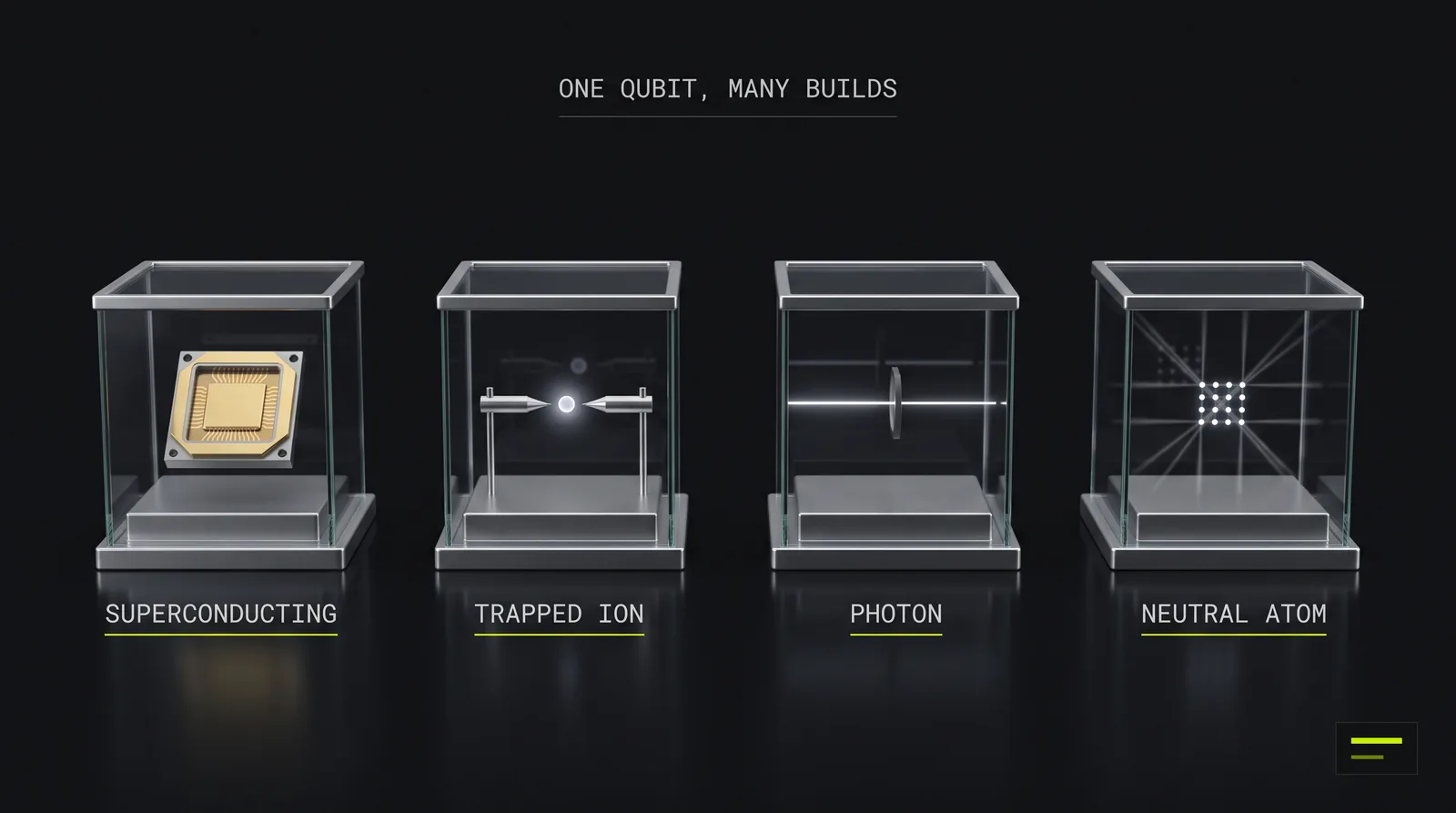
A qubit is a mathematical idea that different physical systems can implement. Superconducting circuits, used by IBM and Google, are engineered loops kept at roughly 10 to 20 millikelvin inside a dilution refrigerator. Trapped ions, used by IonQ and Quantinuum, are single atoms held in an electromagnetic field and controlled with lasers. Neutral atoms are held in place by focused laser beams. Photons can encode a qubit in properties such as polarization, and the spin of a single electron works too.
These are very different engineering problems, but they all implement the same qubit mathematics. That is why "how many qubits" is a weak way to compare quantum computers. What matters at least as much is how good the qubits are: how long they stay coherent and how low their error rates are. Error correction then combines many noisy physical qubits into fewer, more reliable logical qubits.
Measuring a qubit
The moment a qubit is measured, its superposition collapses to a definite 0 or 1, and which one you get is random, weighted by the amplitudes. This is why quantum programs are run many times, each run called a shot, and the results are read as a histogram instead of a single return value.
It also means a qubit does not hold unlimited information, whatever a headline says. The amplitudes are continuous numbers, but a single measurement gives you exactly one bit. Figure 3 shows the simplest useful circuit: a Hadamard gate takes a qubit from |0⟩ to an equal superposition, so measuring it gives 0 or 1 with probability one half each.
Try it livePut a real qubit into superposition and watch the vector move on an interactive Bloch sphere in the Bloch Sphere simulation.
Quantum States is Quantum Discord's free introductory course. It builds the qubit from the ground up, with the Bloch sphere, superposition, a live workshop and interactive simulations.
Explore the Quantum States courseWatch a qubit pass through gates and measurement in the Circuit Builder. No install needed.