What Is Quantum Computing?
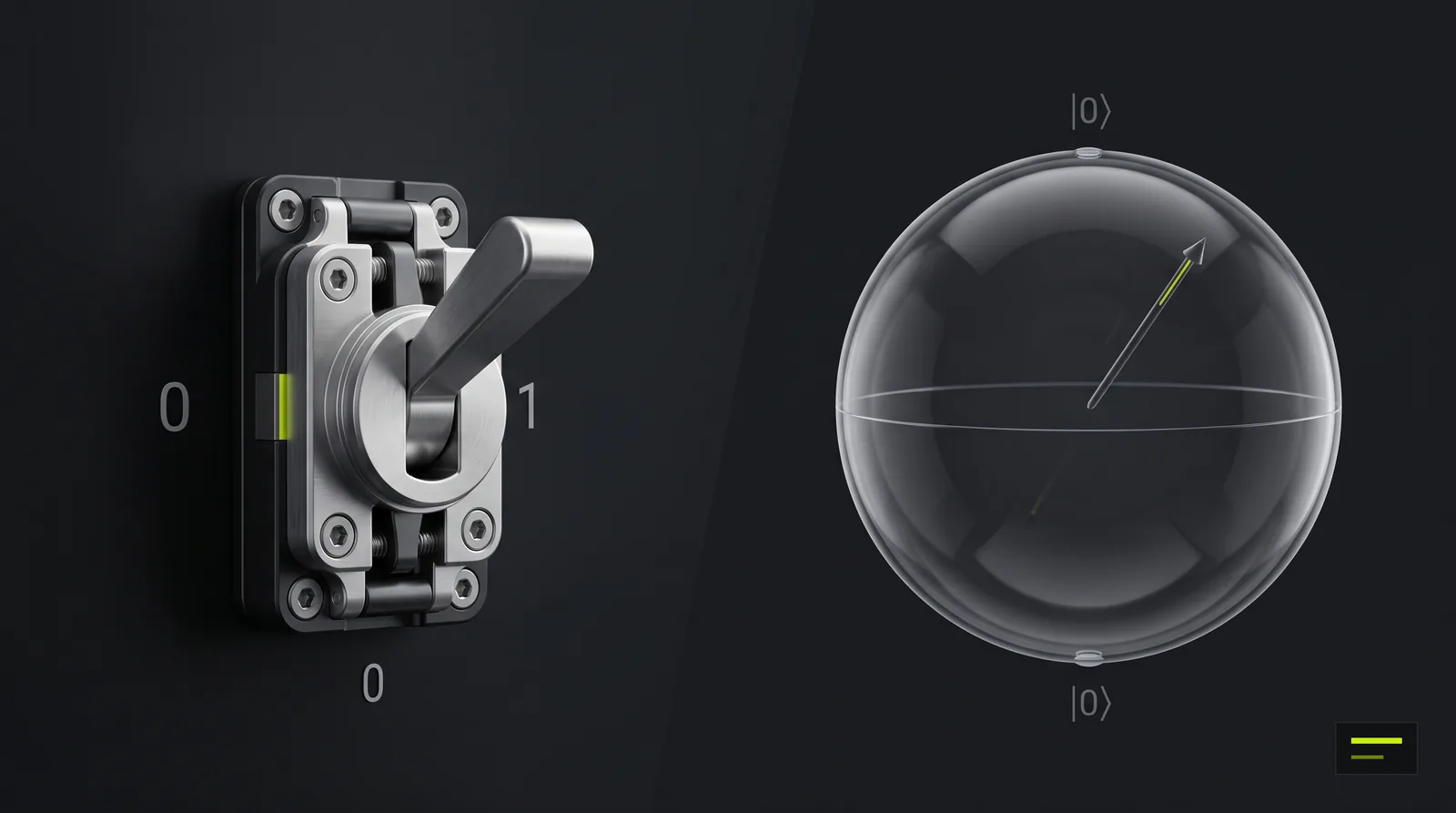
Quantum computing is a way of processing information using the physics of very small things: electrons, photons and single atoms. A quantum computer is not a faster laptop. It is a different kind of machine, built for a narrow set of problems that ordinary computers find brutally hard.
Real quantum computers exist, and you can run programs on them from a browser today. They are also wrapped in more hype than almost any other technology. So this guide does two jobs: it explains how a quantum computer works, and it is straight about what one cannot do.
Bits and qubits
Every computer you have used stores information as bits, tiny switches that are either 0 or 1. A quantum computer stores information in qubits. A qubit is still read out as a 0 or a 1, but before you read it, its state is a weighted mixture of both, described by two numbers called amplitudes. Amplitudes are the whole difference. They can be added, subtracted, and made to cancel each other.
A picture that helps: a classical bit is a coin lying flat on a table, heads or tails, already decided. A qubit is more like a coin still spinning in the air. It is not simply heads and tails at the same time. It is in a distinct physical state that only becomes heads or tails when you catch it and look. That looking is called measurement, and it is the only way to ever read a qubit out.
Superposition, entanglement and interference
Three ideas do the work, and it helps to keep them separate.
Superposition means a qubit's state is a weighted combination of 0 and 1. It is not secretly one or the other, and it is not literally both at once either. The superposition explainer covers why both of those common descriptions miss.
Entanglement links qubits so that their joint state cannot be described one qubit at a time. This is where the scaling comes from. Describing n entangled qubits takes 2n amplitudes, so 50 qubits already need over a million billion numbers. To simulate that exactly, a classical computer generally has to track all of them. A quantum computer simply is the system.
Interference is the ingredient that actually computes. A quantum algorithm arranges the amplitudes so that paths leading to wrong answers cancel and paths leading to the right answer reinforce. It does not try every answer at once and pick the best one. That popular story is wrong, and the correct version is more interesting.
What quantum computers may be good at
A speedup is expected only for specific kinds of problems, and the list is short.
- Simulating quantum systems. Richard Feynman proposed the idea in 1981: use a quantum system to model another one. Molecules and materials are quantum systems, and classical computers scale badly at modeling them. This is the clearest case.
- Factoring large numbers. Shor's algorithm (1994) factors integers far faster than any known classical method, which is why it threatens RSA encryption. See what a quantum algorithm is.
- Searching and optimization. Grover's algorithm gives a quadratic speedup for unstructured search. That is useful but modest, and the case for real-world optimization is still being tested.
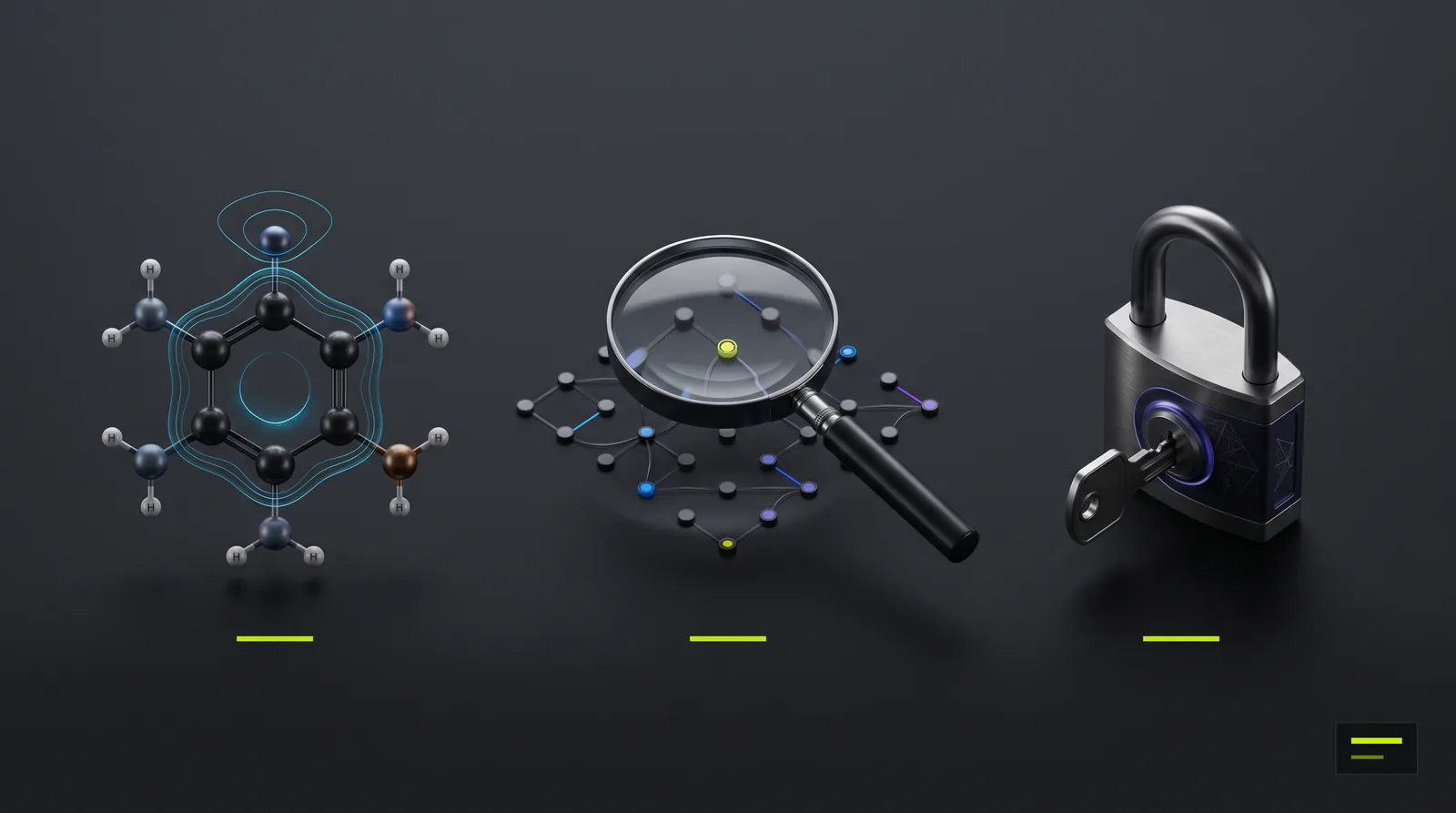
For a closer look at where each of these stands in practice, read what quantum computers are used for.
What quantum computers are not
They are not replacements for your laptop. For spreadsheets, video, browsing and nearly every everyday task, a classical computer is faster, cheaper and more reliable, and will stay that way. The comparison is laid out in quantum vs classical computing.
The hard part is noise. Qubits lose their quantum state after a short time, a problem called decoherence, and every gate adds a little error. Today's machines are small and noisy, often called NISQ devices (noisy intermediate-scale quantum). Fixing that needs quantum error correction, which spreads one reliable logical qubit across many physical ones. In December 2024, Google reported in Nature that adding qubits to an error-correcting code made its error rate fall instead of rise. That is a necessary step, and still far from a finished machine.
My honest summary: as of 2026, I am not aware of a widely accepted, verified case of a quantum computer beating the best classical method on a commercially useful task. That is not a reason to dismiss the field. The physics and the proven speedups are real. It is a reason to ask for a source whenever a headline says otherwise.
How to try it yourself
You do not need a lab. IBM's free Open Plan gives up to 10 minutes of real quantum hardware time per rolling 28 days, and the major clouds all offer simulators. If you would rather start with no account, the Circuit Builder on this site runs in your browser. There is a longer, sourced comparison of free options in how to learn quantum computing without expensive hardware.
Frequently asked questions
Is quantum computing real?
Yes. Working quantum computers exist, and companies such as IBM and Google let people run programs on them over the cloud. What is still missing is scale and reliability. Today's machines are small and noisy, so they have not yet replaced any classical workload.
Will quantum computers replace classical computers?
No. Classical computers stay better for almost every everyday task. The realistic future is hybrid, with a classical computer doing most of the work and calling a quantum processor for narrow sub-problems, such as simulating a molecule.
What is the difference between a bit and a qubit?
A bit is either 0 or 1. A qubit is also read out as 0 or 1, but before measurement its state is a weighted combination of both, described by amplitudes that can interfere. Measuring gives one definite answer, with probabilities set by those amplitudes.
Can a quantum computer break encryption?
In principle, yes, for RSA and elliptic-curve encryption, using Shor's algorithm. In practice no such machine exists. A 2025 estimate by Google's Craig Gidney put RSA-2048 at under a million noisy qubits running for under a week, far beyond today's hardware. NIST published its first post-quantum encryption standards in August 2024 so systems can switch early.
Do I need a physics degree to learn quantum computing?
No. The core prerequisite is linear algebra with complex numbers, plus basic probability. If you can work with vectors and matrices, you can start. See the math you need.
Quantum States is Quantum Discord's free introductory course. It takes you from bits to qubits, superposition and the Bloch sphere, with a live workshop and interactive simulations.
Explore the Quantum States coursePut a qubit on the sphere in the Bloch Sphere simulation, or build a circuit in the Circuit Builder. No install needed.
- Google Quantum AI, "Quantum error correction below the surface code threshold," Nature, Dec 2024. www.nature.com/articles/s41586-024-08449-y
- IBM Quantum documentation, plans overview (Open Plan). quantum.cloud.ibm.com/docs/en/guides/plans-overview
- C. Gidney, "How to factor 2048 bit RSA integers with less than a million noisy qubits," 2025. arxiv.org/abs/2505.15917
- NIST, first three finalized post-quantum encryption standards, Aug 2024. www.nist.gov/news-events/news/2024/08/nist-releases-first-3-finalized-post-quantum-encryption-standards