What Is Quantum Technology?
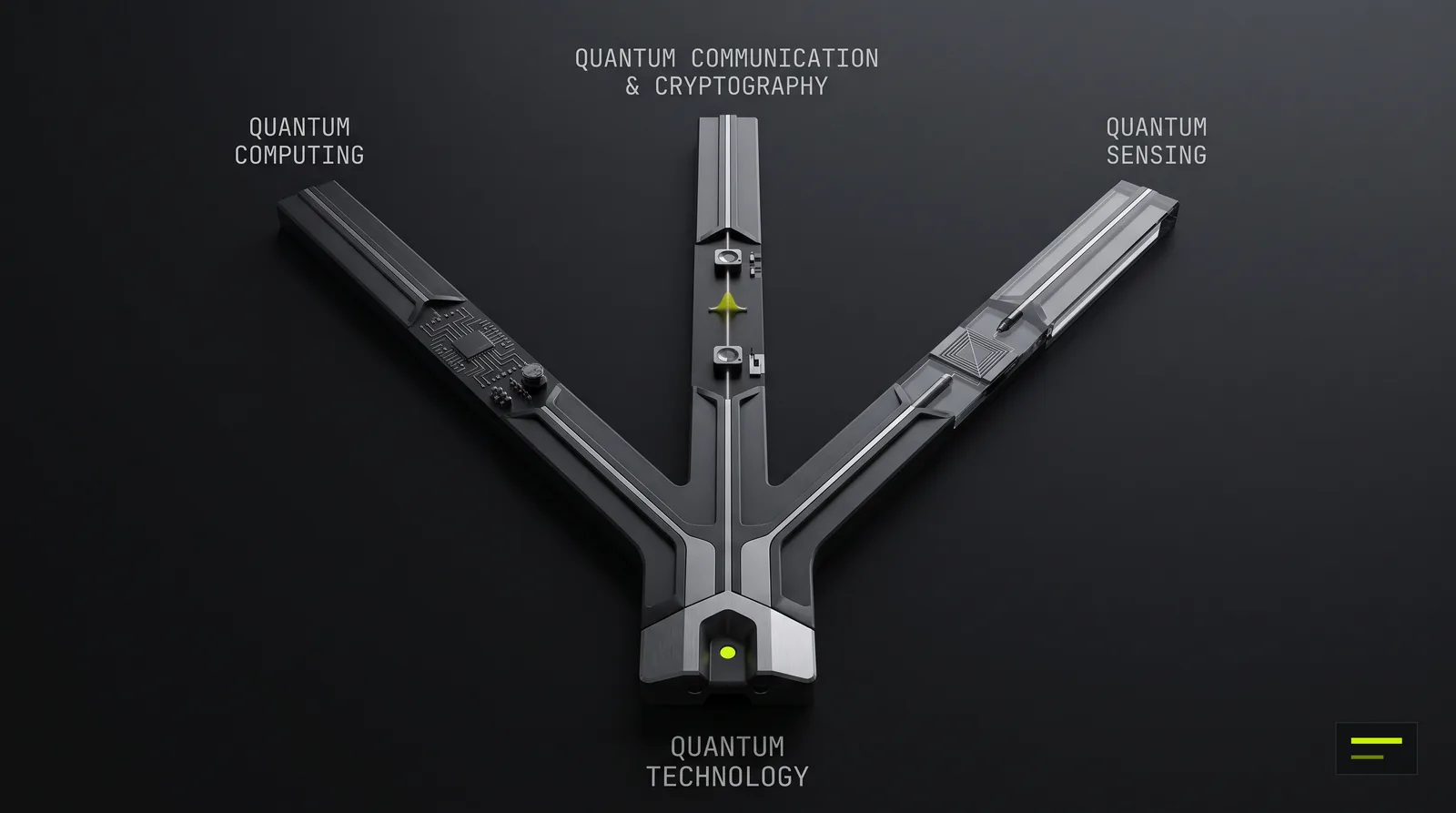
Quantum technology is the umbrella term for devices and systems that put quantum effects such as superposition and entanglement to practical use. It has three main branches: quantum computing, quantum communication and cryptography, and quantum sensing. Computing gets the headlines, but sensing is the branch that already works in the field.
All three rest on the same physics, but they are separate engineering disciplines with different hardware, different companies and very different timelines. This article takes each branch in turn, then explains why they get confused.
Quantum computing
Quantum computing uses qubits to process information, aiming at a narrow set of problems that classical computers find very hard, such as simulating molecules or factoring large numbers. It is the branch this site focuses on, and it is still mostly a research and early-enterprise field. The full picture is in what is quantum computing.
Quantum communication and cryptography
This branch uses quantum physics to protect information in transit. The best known method is quantum key distribution, first proposed in 1984. Because measuring a quantum signal disturbs it, an eavesdropper leaves a detectable trace, so two parties can tell whether their shared key was intercepted. Range is the main limit: fiber loses photons, so researchers are also sending quantum signals through satellites. In 2017 the Micius satellite distributed entangled photons between ground stations more than 1,200 km apart.
Do not confuse this with post-quantum cryptography. That is ordinary classical mathematics designed to resist future quantum computers, and it needs no special hardware. Quantum key distribution is a different tool with different trade-offs, and it is still in early pilots.
Quantum sensing and metrology
Sensing uses quantum effects to measure things, such as time, magnetic fields and gravity, with a precision classical instruments cannot reach. It is the most mature branch. Atomic clocks are already fielded products, quantum magnetometers are entering field trials in areas such as medical imaging and mineral exploration, and quantum gravimeters, which can map what lies underground, are mostly in pre-commercial trials.
Why the three get confused
They share a foundation of superposition, entanglement and how quantum systems behave when measured, so they are often reported together. But the timelines differ. Some forms of sensing are deployed, communication is in early pilots, and general-purpose quantum computing is still largely research. Conflating them is one of the most common sources of hype in quantum reporting. A headline about a sensing breakthrough is not evidence that quantum computers are close.
Why governments fund all three
Quantum technology is treated as strategic, and national programs usually cover the whole field. India's National Quantum Mission, approved in April 2023 with an outlay of about Rs 6,004 crore through 2030-31, funds four thematic hubs: quantum computing, quantum communication, quantum sensing and metrology, and quantum materials and devices.
Where to start
It depends on what you want to do. If you are drawn to computing, start with qubits and measurement. If sensing or communication interests you, the same foundation still applies, and the career picture is laid out in what quantum careers exist. The realistic near-term uses of the computing branch are covered in what quantum computers are used for.
Frequently asked questions
Is quantum technology the same as quantum physics?
No. Quantum physics is the science: the theory of how matter and light behave at very small scales. Quantum technology is engineering built on it, such as quantum computers, key distribution links and atomic clocks.
Is quantum communication unhackable?
Not in an absolute sense. Quantum key distribution is secure in theory because eavesdropping disturbs the signal and shows up. Real systems can still be attacked through flaws in their hardware and surrounding software, so security depends on careful engineering as well as the physics.
What is quantum sensing used for?
Measuring very small changes in time, magnetic fields and gravity. Uses include precision timekeeping, medical imaging, mineral exploration and mapping underground structures. Atomic clocks are already deployed, and other sensors are in trials.
Is any quantum technology already in everyday products?
Yes, in older forms. Lasers, transistors and MRI machines all rest on quantum physics, and satellite navigation depends on atomic clocks. Newer technologies such as quantum computers are mostly still in research and early deployment.
Do I need to learn quantum computing to work in quantum technology?
Not necessarily, but the shared foundation of superposition, entanglement and measurement applies to all three branches. The day-to-day work differs: sensing leans toward physics and instrumentation, communication toward optics and security, computing toward software and hardware.
Quantum States is Quantum Discord's free introductory course. It builds the shared foundation underneath all three branches, with a live workshop and interactive simulations.
Explore the Quantum States course- Department of Science & Technology, Government of India, National Quantum Mission. dst.gov.in/national-quantum-mission-nqm
- J. Yin et al., "Satellite-based entanglement distribution over 1200 kilometers," Science, 2017. www.science.org/doi/10.1126/science.aan3211
- The Quantum Insider, "Understanding Quantum Sensing and Its Industrial Potential," Mar 2026. thequantuminsider.com/2026/03/02/understanding-quantum-sensing-industrial-potential/