What Is Superposition?
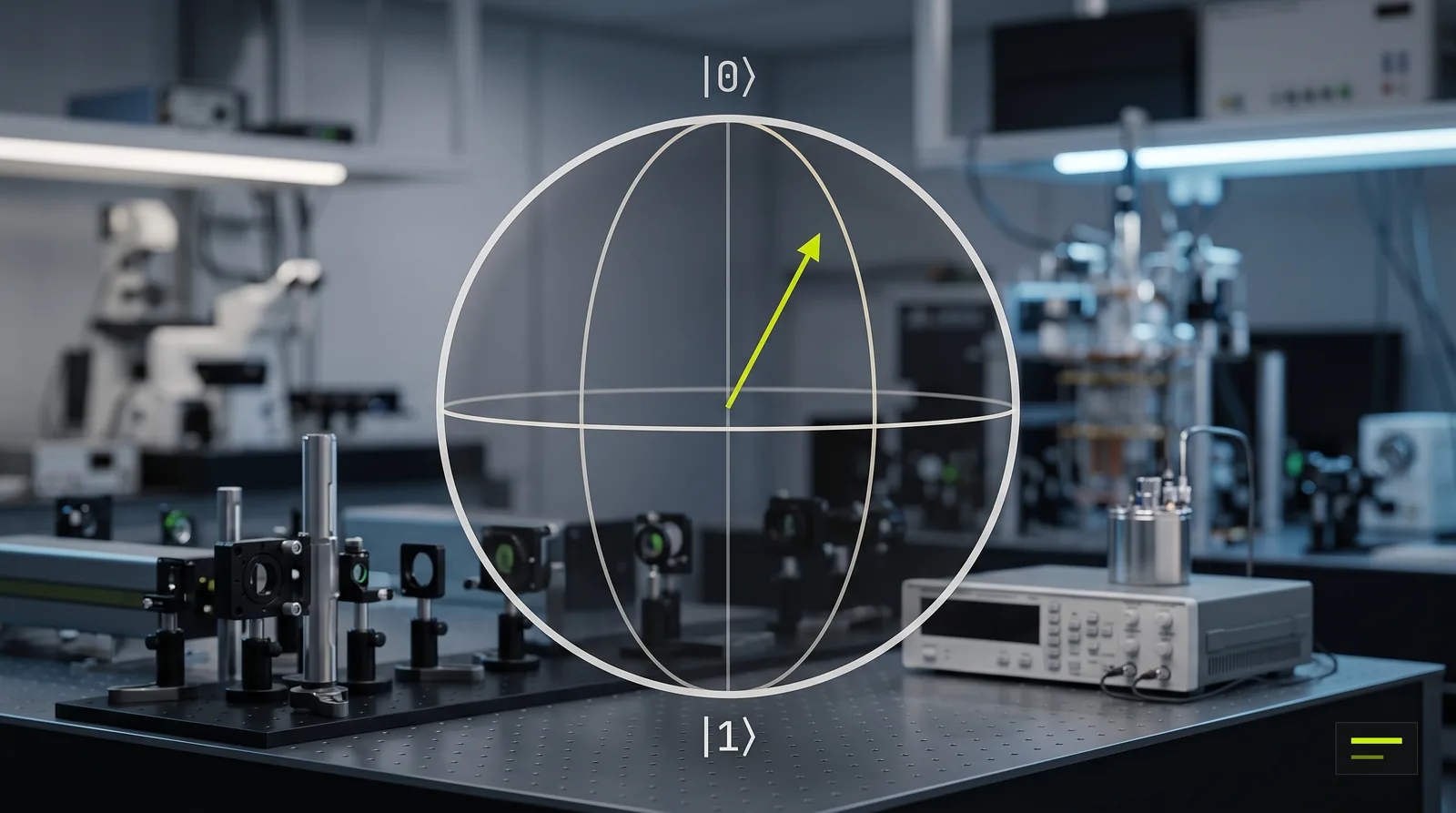
Superposition means a qubit's state is a weighted combination of 0 and 1, and it only becomes a definite 0 or 1 when you measure it. It is neither "both at once" nor "secretly one of them", and the gap between those two descriptions is the whole story.
Superposition is described badly more often than almost any other idea in physics. This article gives the accurate picture, shows the math in a single line, and explains why it matters for computing.
Why "both at once" oversells it
You will never observe a qubit reading out "0 and 1" together. A measurement always gives exactly one definite answer. Saying the qubit is literally both values at once suggests a kind of double existence that no experiment ever shows. What exists before measurement is one specific state, a combination of the two, and that state is different from either 0 or 1 alone.
Why "secretly one or the other" undersells it
The opposite description treats the qubit like a coin under your hand: already heads or tails, just unseen. That is ordinary ignorance, and it does not match what experiments show. Take a single photon sent through an interferometer, which offers two paths. The output depends on the relative phase between the two paths. If the photon were secretly taking one path, the phase of the other path could not matter. It does matter, so both possibilities are contributing before anything is measured.
The math in one line
A qubit's state is a linear combination of the 0 state and the 1 state, weighted by complex numbers called amplitudes.
The squared size of each amplitude gives the probability of that outcome. With \(\alpha = \beta = 1/\sqrt{2}\), measuring gives 0 or 1 with probability one half each. Now flip the sign, so \(\beta = -1/\sqrt{2}\). The measurement probabilities are identical, yet it is a different state. The difference is the relative phase, and it shows up as soon as you let the amplitudes interfere.
One more subtlety: superposition depends on the basis you choose. The state \(|+\rangle = (|0\rangle + |1\rangle)/\sqrt{2}\) is an equal superposition when you measure in the 0/1 basis, but it is a single definite state in the basis built from \(|+\rangle\) and \(|-\rangle\). So "superposition" describes a state relative to a measurement, not a label some states carry and others lack.
Why superposition matters for computing
Amplitudes can add up or cancel, the way overlapping waves do. That interference is the resource quantum algorithms use, and it is the real reason superposition matters, not the loose idea of "being in two states". You can see how it works in what a quantum computer actually does.
On its own, superposition on a single qubit is fairly limited. Its power shows up once you combine it with entanglement across many qubits, where the number of amplitudes grows exponentially and the state space outgrows anything classical bits can represent efficiently. The qubit explainer covers the building block, and the comparison with classical computing shows where that growth does and does not pay off.
Put a qubit into superposition yourself in Quantum States, our free introductory course. It covers the Bloch sphere, measurement and the math above, with a live workshop and interactive simulations.
Explore the Quantum States courseWatch a state move on the sphere in the Bloch Sphere simulation.