Quantum vs. Classical Computing
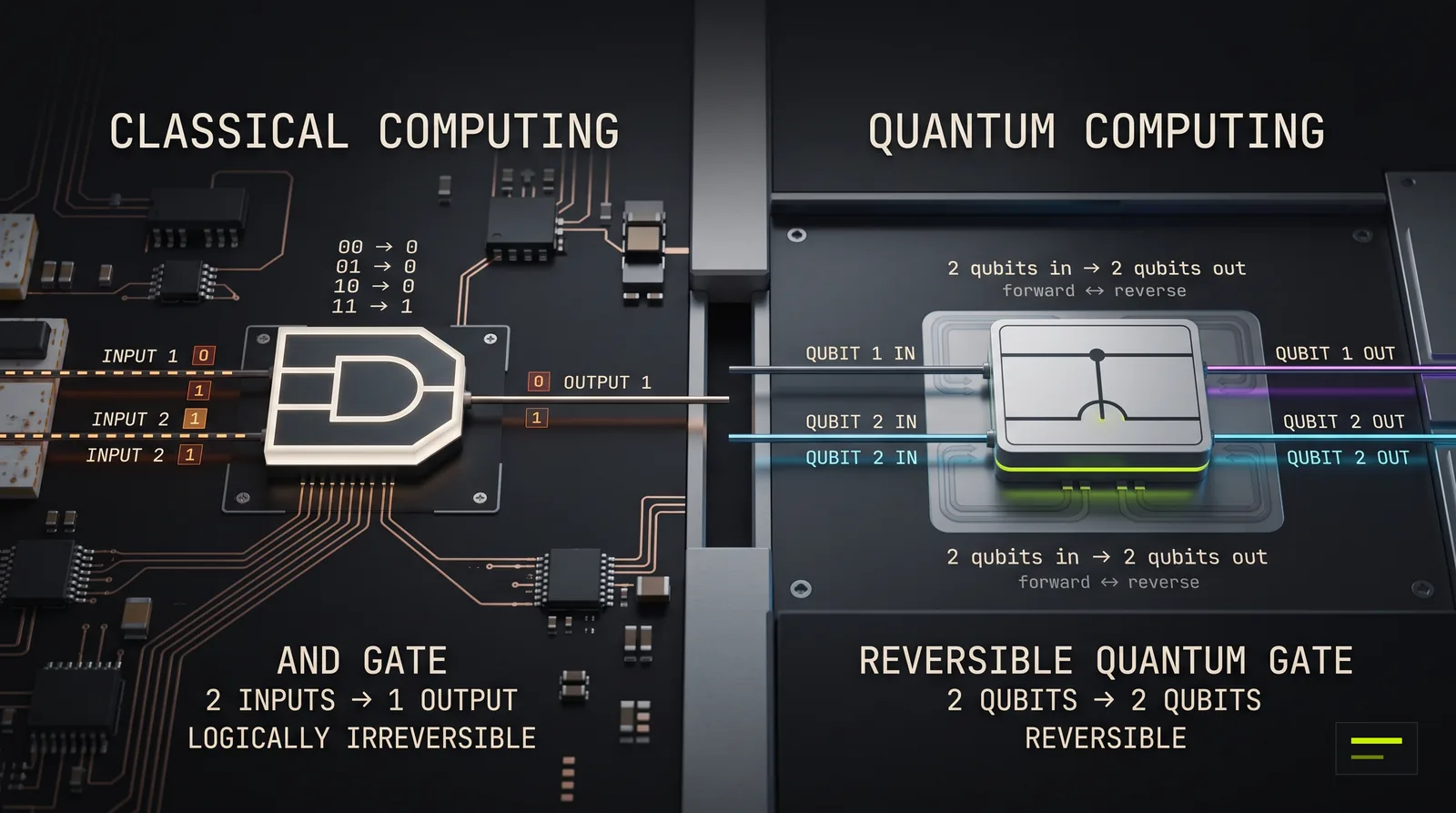
Quantum computers are not a faster version of classical computers. They follow a different model of computation, and for almost every everyday task a classical computer stays faster, cheaper and more reliable. The useful question is not which one wins, but which problems each one suits.
This article sets the two side by side: how they process information, why quantum gates behave differently, where today's quantum hardware falls short, and how the two are expected to work together.
Same job, different physics
A classical computer stores bits and changes them with logic gates such as AND, OR and NOT. Given the same input, it gives the same output every time. A quantum computer stores qubits and changes them with quantum gates. Its output is probabilistic, so a quantum program is run many times and the answer is read from the statistics of the results. Two runs of the same circuit can print different values, and that is by design.
Reversible gates and interference
Here is a structural difference that has nothing to do with speed. A classical AND gate maps both (0,0) and (0,1) to the output 0. You cannot work backward from that output to know which input produced it. Classical computing throws that information away on purpose, because it does not need it.
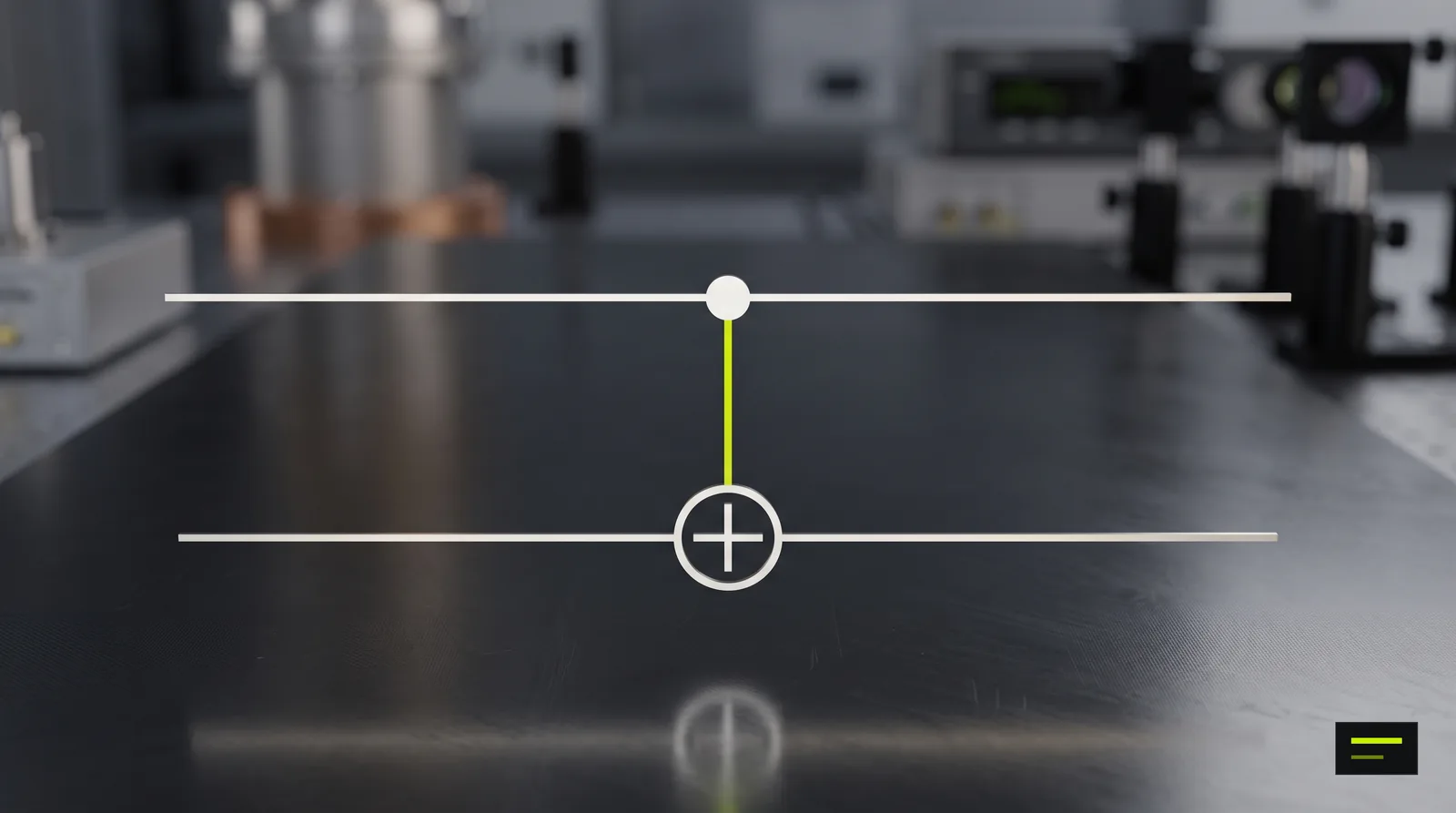
A quantum gate must be reversible. That is a consequence of the underlying physics, not a design choice. Every quantum gate can be undone, and the two-qubit CNOT gate is even its own inverse: apply it twice and you are back where you started. Reversibility is also what lets a quantum computer use interference, where wrong answers cancel and right ones reinforce. That is the real computational trick, and classical bits have no equivalent.
What each one is good at
Classical computers are the right tool for nearly everything: databases, graphics, the web, training machine-learning models on large datasets. Quantum computers are expected to help only where the structure of the problem fits, such as simulating quantum systems or factoring large numbers. Even there, a quantum computer is poor at handling large amounts of ordinary data. Getting classical data into qubits is expensive, so problems that are mostly "read a lot of data, do a little math" tend to stay classical.
Where quantum computers fall short today
Today's machines are usually called NISQ devices, short for noisy intermediate-scale quantum. Their qubits lose their quantum state after a short time, a problem called decoherence, and every operation adds a little error. Large, fully error-corrected quantum computers, the kind that could reliably beat classical machines on hard and useful problems, do not exist at meaningful scale yet. Most credible results so far are small proof-of-concept demonstrations, or "quantum advantage" experiments on problems chosen to favor quantum hardware. They are not general business computing.
How the two will work together
The realistic picture most researchers hold is hybrid. A classical computer handles the data, the control software and the error decoding, and calls a quantum processor for the specific sub-problems where it may help, such as simulating a molecule. Variational algorithms already work this way: a classical optimizer tunes the settings of a quantum circuit, over and over. "Quantum will replace classical computing" is not the claim serious researchers make.
Frequently asked questions
Are quantum computers faster than classical computers?
Only on specific problems, and only in principle so far. For everyday work such as browsing, spreadsheets and video, a classical computer is faster and cheaper. Proven quantum speedups exist for a short list of problems, such as factoring and unstructured search.
Can a quantum computer run normal software like Windows or a web browser?
No. Quantum computers do not run ordinary programs. You write a quantum circuit for a specific problem, and a classical computer prepares it, sends it to the quantum processor and reads back the results.
Can a classical computer simulate a quantum computer?
Yes, but the cost grows exponentially with the number of qubits, because the state needs 2n amplitudes. Small circuits simulate easily. Somewhere around 50 well-behaved qubits, exact simulation of the full state becomes impractical.
Will quantum computers replace classical computers?
No. Classical computers stay better for almost every task, and quantum processors are expected to act as specialized accelerators alongside them for a narrow set of problems.
How many qubits equal a classical computer?
There is no exchange rate. Qubit count alone tells you little, because error rates and coherence time matter just as much. A machine with fewer, cleaner qubits can outperform one with many noisy ones, and what counts is whether a useful algorithm can run to the end.
Quantum States is Quantum Discord's free introductory course. It shows exactly how a qubit differs from a bit, with a live workshop and interactive simulations.
Explore the Quantum States courseSee the difference in practice with real circuits in the Simulations gallery or the Circuit Builder.