Data Scientist → Quantum Machine Learning: Is It Real Yet?
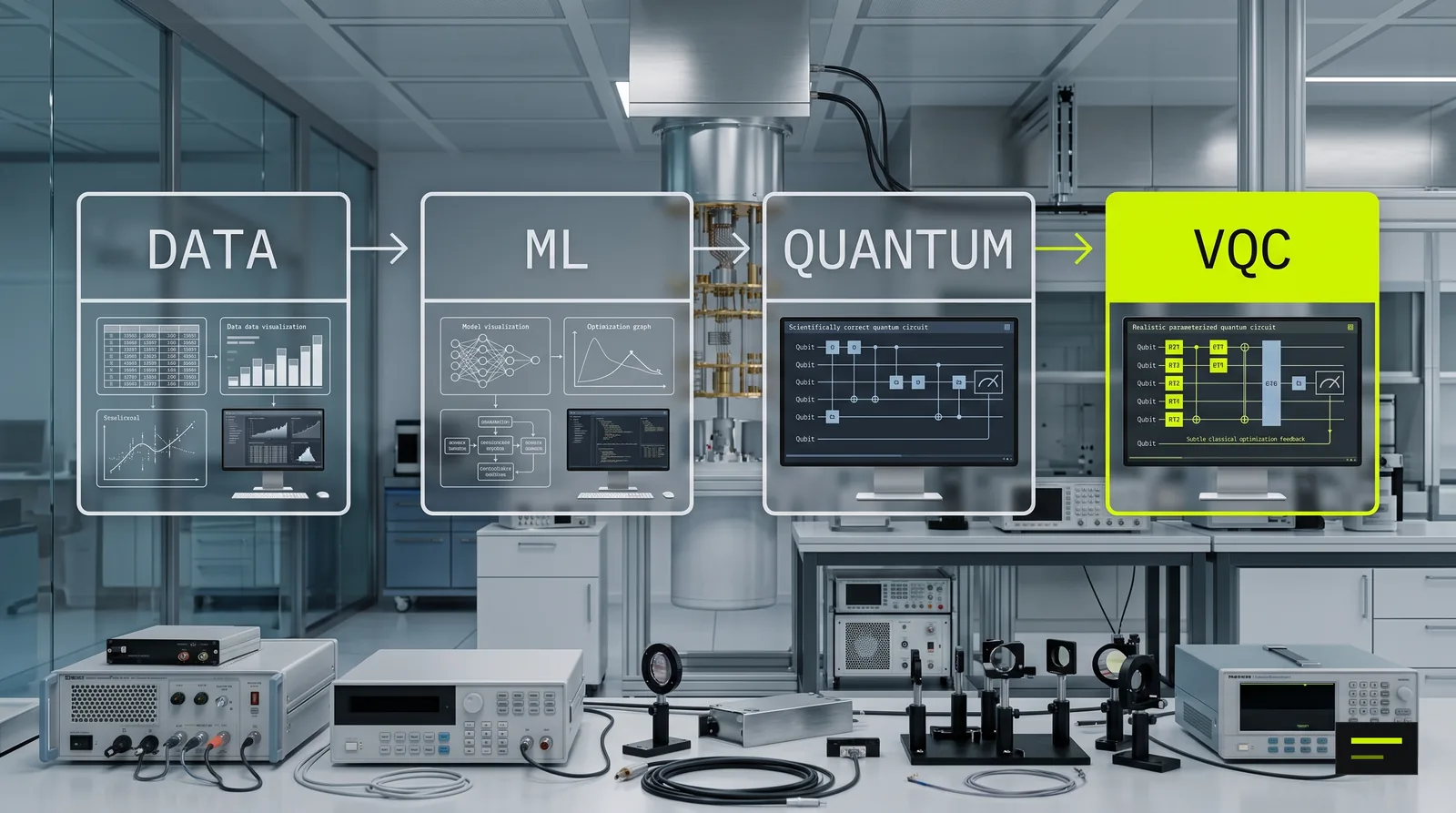
Quantum machine learning (QML) is a genuine, active research area, but it is earlier-stage and more speculative than most other quantum applications. For a data scientist it is worth exploring, and not yet a stable career track of its own. Your statistics and model-evaluation skills transfer well. A clear quantum advantage over classical machine learning has not been established.
This pathway explains what QML actually is, what carries over from your current skills, where the evidence stands, and a sensible way to start without betting your career on it.
What quantum machine learning actually is
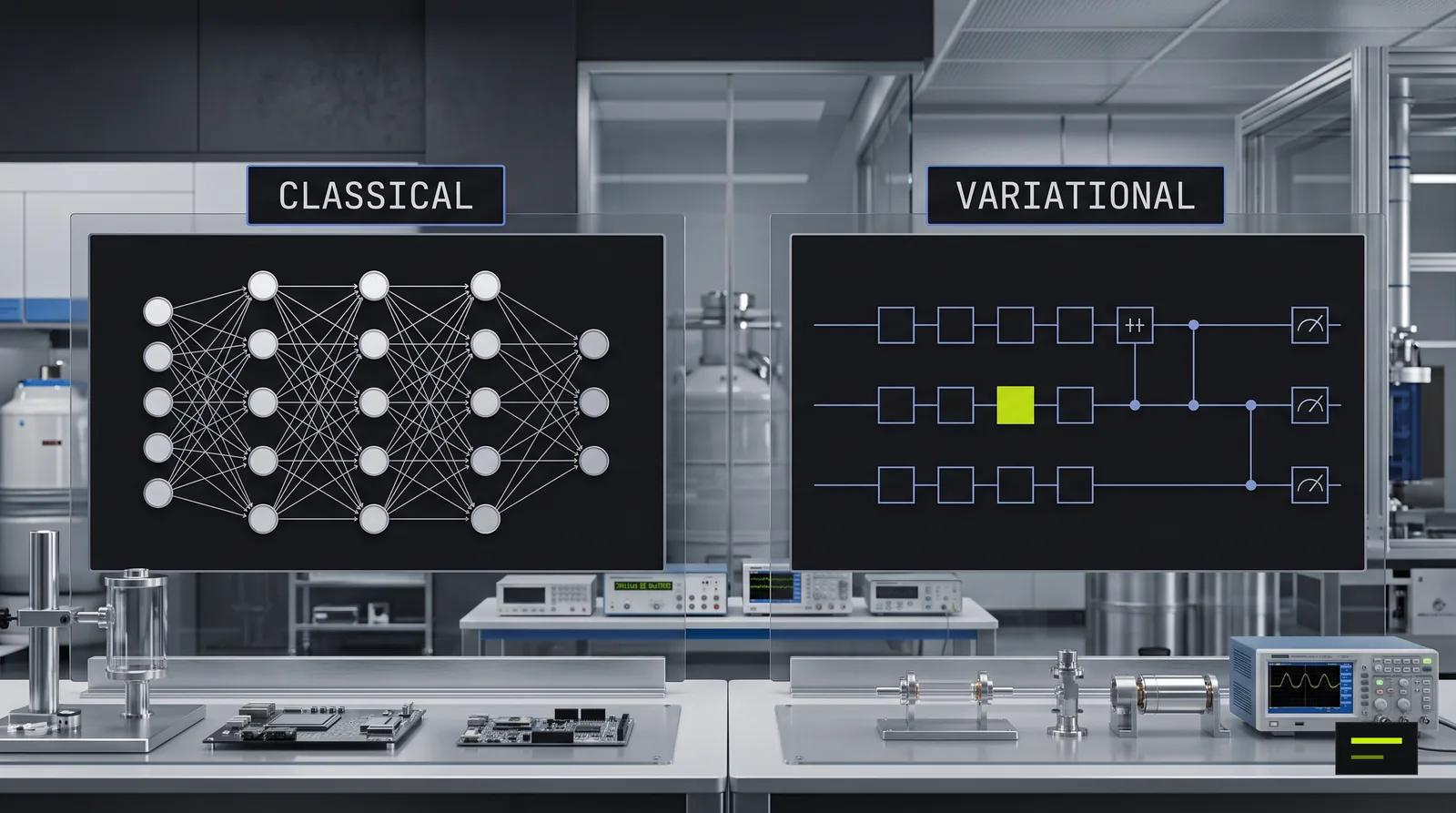
Most current QML research follows two ideas. In the first, a variational quantum circuit acts as a trainable model: a circuit with adjustable parameters, tuned by a classical optimizer that runs in a loop with the quantum device. In the second, quantum-enhanced kernels use a quantum circuit to compute a similarity measure between data points, which is then fed to a classical method such as a support vector machine. Both are hybrid, so the classical machine-learning machinery you know stays central.
What transfers from data science
A data scientist's background of statistics, model evaluation and comfort with high-dimensional mathematics transfers directly to reasoning about these methods. So do habits such as building honest baselines, cross-validating and being suspicious of results that look too good. Python is the common language, and PennyLane, one of the main QML libraries, is designed around automatic differentiation and integrates with PyTorch and TensorFlow, so training a quantum circuit can feel a lot like training a neural network.
Where the field really stands
Being direct: most current QML results are demonstrated on small or simulated problems. A clear, reproducible quantum advantage over classical machine learning has not been established the way it has for factoring or chemistry simulation. Two known obstacles are worth naming. Some parameterized circuits suffer from barren plateaus, where gradients vanish exponentially as the circuit grows, making training impractical. And some celebrated quantum speedups for machine-learning tasks have been matched by classical algorithms. Ewin Tang's 2018 result did exactly that for a quantum recommendation-system algorithm.
In hiring terms, "quantum ML engineer" is rarely a standalone job title today. It usually shows up as a research-adjacent specialization inside a broader machine-learning or quantum research role, not a mainstream career path yet. The wider career picture is in what quantum careers exist.
A further practical limit is data. Getting classical data into qubits is itself expensive, so any advantage on large datasets has to survive that loading cost. It is one more reason to compare against a strong classical baseline, not a weak one.
A sensible way to start
If you are genuinely curious and not pivoting careers immediately, treat this as exploration, not a job search. Build fluency with quantum circuits first. Then train one small variational classifier on a toy dataset and compare it, honestly, against a classical baseline of similar size. Then track the research instead of the job boards. If a stable QML career track does form, understanding the fundamentals now is what lets you recognize it early. The math and programming you need are both shorter lists than they look.
Start with the fundamentals. Quantum States is Quantum Discord's free introductory course, with a live workshop and interactive simulations. A dedicated machine-learning course is not part of the curriculum, so this is the honest starting point today.
Explore the Quantum States courseBuild a simple parameterized circuit in the Circuit Builder.
- E. Tang, "A quantum-inspired classical algorithm for recommendation systems," 2018. arxiv.org/abs/1807.04271
- PennyLane, "Barren plateaus in quantum neural networks" (tutorial covering McClean et al., Nature Communications, 2018). pennylane.ai/qml/demos/tutorial_barren_plateaus/